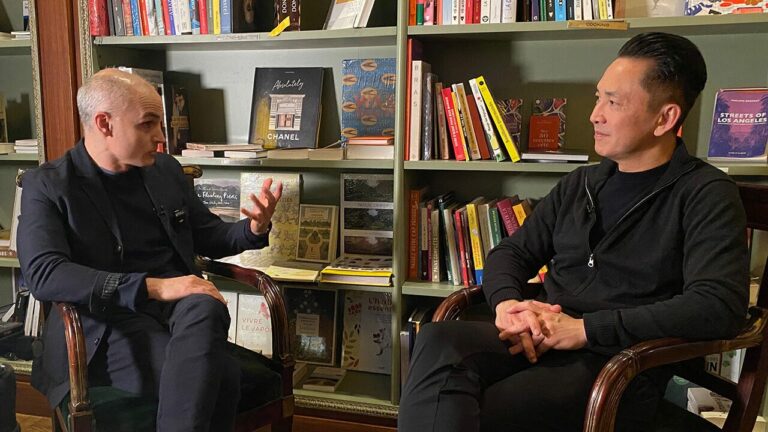
TRANAN SESSIONS | Viet Thanh Nguyen

VIET THANH NGUYEN was born in 1971 in Vietnam but grew up in the United States, where he fled with his parents as a four-year-old. He is a professor at the University of Southern California and regularly contributes as a writer to the New York Times and Time Magazine, where he has made a name for himself as a strong voice for the Asian-American minority in the United States. In 2020, he was appointed honorary doctorate at Uppsala University. Produced by Bokförlaget Tranan, TRANAN SESSIONS is a seven part series of mini-documentaries where Nguyen discusses his life and how he got to where he is now .

Viet Thanh Nguyen:

I think that there was a time in my life when I read everything that was written about The Sympathizer. By that I mean not just the professional reviews, but also amazon.com, Goodreads, all of that. And so I think I had a pretty good sense of what readers like and didn’t like about that novel. And I don’t think, again, the point is still subtle that I don’t think most people who didn’t like the book were saying, “He didn’t translate to us.” That’s not what people are thinking. Their reactions, however, are symptomatic of not being translated to, not being catered to, starting with maybe a lack of explanation in the novel. There are some readers say, “I needed more explanation of the politics or the history and so on.”

And I refuse to do that. That’s a translating function too. Because when I pick up a Jonathan Franzen novel or any novel by a white person, I don’t expect to be translated to. I don’t expect to have American history or culture or politics or whatever rendered specifically for me. I know the expectation is I have to come to meet the novel. And again, for a certain percentage of readers who dislike a novel like The Sympathizer, they’re not going to say that, but they’re going to react in that way of people who are rendered uncomfortable because for once they’re not being spoonfed information that they expect minorities to give to them.

And I think that I’ve also talked about how the novel was rejected by 13 out of 14 editors of major New York publishers. And of course no one ever said, “I’m not being catered to,” but that must be one of the reasons. I think there was one editor who wrote in his rejection, “I couldn’t crawl into the voice.” I’m like, “What does that mean?” But I think that was, again, symptomatic of the fact that people are making all kinds of subconscious decisions about what they like to read and don’t like to read. And that made it actually fairly explicit. They want to crawl into a voice. They want to feel as if there’s no friction between them and the book and the author that they’re encountering.

Viet Thanh Nguyen:

In the United States, it’s clearly the case that I am a Vietnamese American or Asian American writer because very often I’ll be introduced that way. Here is Viet Nguyen, the Vietnamese American writer, which I don’t necessarily have a problem with. I don’t have a problem with being identified with adjectives of various kinds. And I’m a proud Vietnamese American and Asian American writer. I believe in our literary movements and our political movements and our identifications, but it is problematic if adjectives are put on me but not put on the writer right next to me or another writer mentioned in the same article who is just simply mentioned as a writer, that’s offensive and that has to be corrected every time that that happens. In the French context, for example, I think that ironically, I’m oftentimes more seen as an American writer than I am in the United States.

So usually in the French context, I will be introduced as an American writer. It’s interesting how strange these shifts can be though, because I remember walking into the department store Be Ash V in Paris and they have a big book section and I found my books under a category called Anglo-Saxon Literature, which I was like, “Wow, that’s interesting.” And I tweeted about that and it generated an interesting response because of course the medievalists were like, “Wait, that’s deeply problematic to be put under Anglo-Saxon literature,” and because Anglo-Saxon in today’s environment of racial politics, which is global, not just in the United States, Anglo-Saxon signifies something along the lines of white supremacy for certain people.

Viet Thanh Nguyen:

What’s also really important is the interviews. And so I’ve been fairly relentless in doing literally hundreds of interviews since 2015 and hundreds of talks in the United States and also outside of it, including in Sweden, because I think I don’t have the luxury of letting my work speak for itself. If I was a white male author, I possibly could do that because of the very plausible assumption that many people around the world would know a lot about white men from the United States simply because of American power and representation and all of that in the United States, because I’ve had to constantly absorb and deal with their representations of themselves. And I’m not complaining about it, it’s just simply a fact.

So therefore, in my situation, I cannot simply hope that the work will go out into the world and people will be able to read it with enough context to really deal with all the nuances all of the time. So the interventions that I have to make are constant in terms of writing essays for newspapers, which do get translated into different languages about refugees, for example, or about the war in Vietnam, or about refugees in general, as you mentioned, that people make a connection between what I’m dealing with in terms of Vietnamese refugees or Southeast Asian refugees and current refugee issues that are happening today in Europe, for example.

Viet Thanh Nguyen:

I think for a lot of readers, American readers, white American readers, they’re not used to not being translated to when they encounter something by a non-white person or a person of color. And so that subtle formal shift at the novel and at the level of the novel did have an impact on the way the novel’s read because the novel’s written from one Vietnamese person to another Vietnamese person. And if you’re having that kind of a dialogue, you’re not going to translate stuff that is already assumed to be the case within Vietnamese. The example that I use often is like, “Hey, look, an author like Jonathan Franzen, if he’s describing someone eating a sandwich, he never has to say, “A sandwich, two slices of bread with some delicious stuff stuffed in the middle.” Whereas a Vietnamese American writer is often expected to say, “Pho, a delicious beef noodle soup,” which we never do in real life with each other.

And so when people hear that, they’re like, “Oh yeah, of course I do that too. Or this is something that is an expectation put upon us.” And so the subtleness of that shift is important because it indicates how deeply held the assumption is that so called minorities in any country, in any context, are expected by the dominant culture to translate themselves constantly and that’s a position … I mean, it’s enormously important to translate, obviously, in certain contexts, in certain ways, but not every day. That’s an existential kind of problem that is a constant level of microaggression that is symptomatic of a larger level of macro aggression in which peoples of color and other marginalized populations are put in. So the refusal to translate is a very important literary and political and personal move that I try to convey explicitly when I talk to audiences, including students.

Viet Thanh Nguyen:

My own work in the American context is deeply critical of the United States. And so when the work is translated outside of the United States and I am cast as an American author, I’m aware that I’m still an American and that there is this American imperialism that is brought along with me. That’s what I meant earlier when I said that myself, being an American writer writing in English, is radically different than being a Vietnamese writer writing in Vietnamese in terms of the reach of my work. And it’s because of imperialism. And that’s a paradoxical situation to be in because, on the one hand, I’m being critical of the United States, but I’m also being given a platform to speak in these other international situations, because I’m an American being critical of the United States. And of course, countries like France absolutely are interested in the critique of American imperialism. So, there’s very few places I can think of that are innocent of the baggage of nationalist expectations and preoccupations.

Viet Thanh Nguyen:

I mean, the reason why genre is very important in both The Sympathizer and the committed is because I love genre. I love detective novels and science fiction and fantasy, even though those don’t come into play in these two books. And the other reason why the question of genre is so important to me is because I’m basically like The Sympathizer divided into two selves. There’s a high-minded self and a low-minded self. And so the high-minded self is apparent in these books because of their literary illusions or philosophical musing, all that kind of stuff. And the ambitions for writing a novel that would be a modernist kind of work. But at the same time, I’m very low-minded in the sense that I like to be entertained. I like genre stories. I like action. I like sex and drugs and violence and all that kind of stuff in my stories.

And so it was just a natural reflex, impulse, to put the genre elements into the novel. I wanted to capture readers, entertain them. And obviously, my belief is that by entertaining them, I could also then introduce the politics and the satire more easily. I’ve read a lot of works of political literature that, for example, have no sense of humor, no sense of entertainment and so on. And I may agree with their politics, but the works are not very entertaining and therefore not very widely read. And so the hope again is that I will seduce readers into reading a novel that is fun to read and then hit them with the serious stuff.

Viet Thanh Nguyen:

We, the unwanted, wanted so much. We wanted food, water, and parasols. Although umbrellas would be fine.

We wanted clean clothes, baths, and toilets, even of the squatting kind, since squatting on land was safer and less embarrassing than clinging to the bulwark of a rolling boat with one’s posterior hanging over the edge.

We wanted rain, clouds, and dolphins. We wanted it to be cooler during the hot day and warmer during the freezing night.

We wanted an estimated time of arrival. We wanted not to be dead on arrival. We wanted to be rescued from being barbecued by the unrelenting sun.

We wanted television, movies, music, anything with which to pass the time.

We wanted peace, love, and justice, except for our enemies whom we wanted to burn in hell, preferably for eternity.

We wanted independence and freedom, except for the communists who should all be sent to reeducation preferably for life.

We wanted benevolent leaders who represented the people, by which we meant us and not them, whoever they were.

We wanted to live in a society of equality, although if we had to settle for owning more than our neighbor, that would be fine.

We wanted a revolution that would overturn the revolution we had just lived through.

In some, we wanted to want for nothing.

What we most certainly did not want was a storm, and yet that was what we got on the seventh day. The faithful once more cried out, “God, help us.” The non-faithful cried out. “God, you bastard.” Faithful or unfaithful, there was no way to avoid the storm, dominating the horizon and surging closer and closer. Whipped into a frenzy, the wind gained momentum. And as the waves grew, our ark gained speed and altitude.

Lightning illuminated the dark furrows of the storm clouds and thunder overwhelmed our collective grown. A torrent of rain exploded on us. And as the waves propelled our vessel ever higher, the faithful parade and the unfaithful cursed, but both, wept.

Then our ark reached its peak and for an eternal moment, perched on the snow-capped crest of a watery precipice. Looking down on that deep wine-colored valley awaiting us, we were certain of two things. The first was that we were absolutely going to die. And the second was that we would almost certainly live.

Yes, we were sure of it. We will live. And then we plunged, hounding into the abyss.

Entire series also available on Youtube.

Share

More Interviews, News, Videos